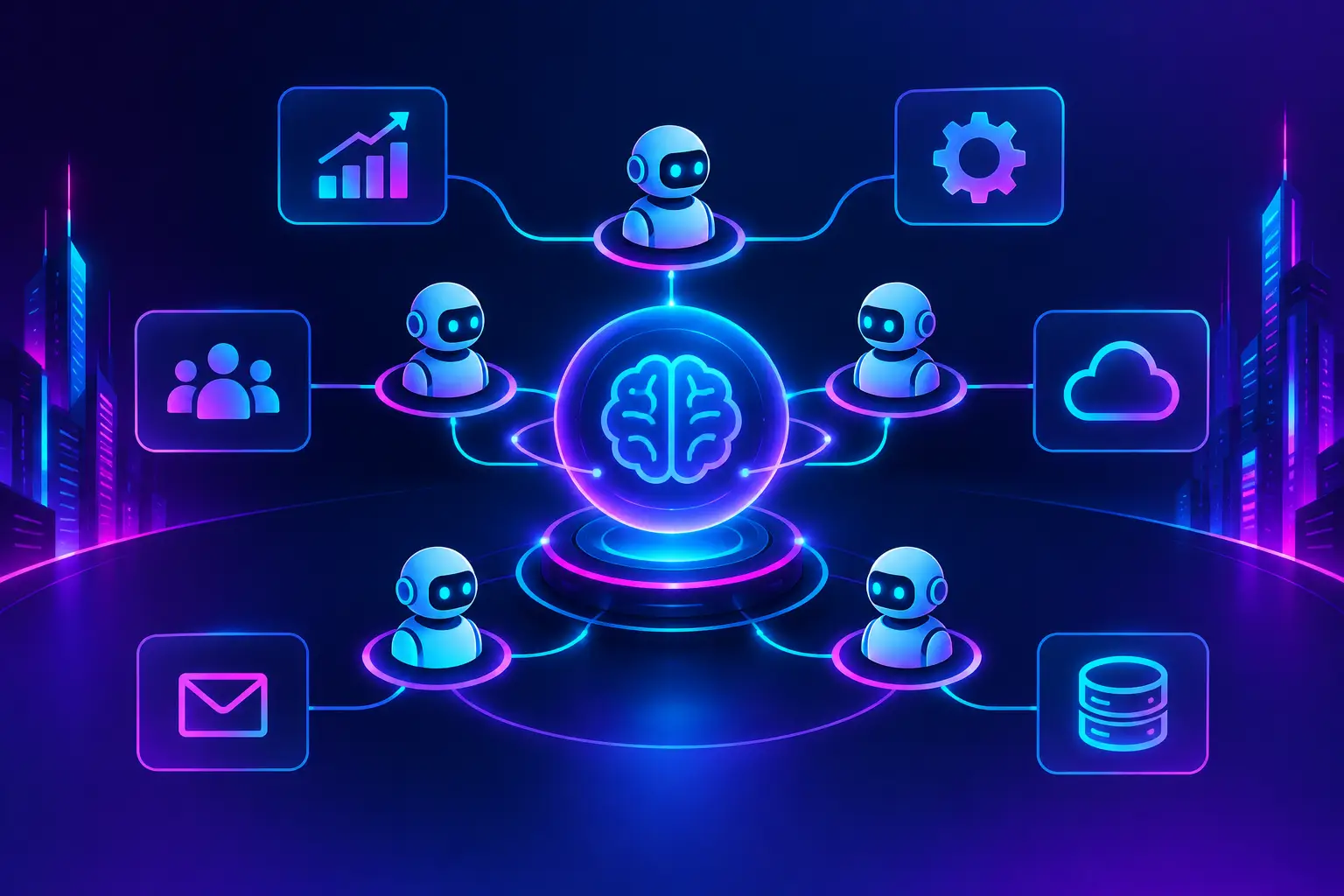
A single AI assistant can draft, retrieve, analyze, and respond. The harder question begins when that assistant must work alongside other agents, enterprise systems, sensitive data, and defined business controls. What is agentic orchestration? It is the operating layer that coordinates AI agents so they can pursue a business objective within clear rules, approved tools, and accountable decision paths.
For business leaders, this is not a narrow technical concern. It determines whether an agentic initiative becomes a controlled capability or an unpredictable collection of demonstrations. As agents take on multi-step work, orchestration establishes who can act, what they can access, when they must ask for approval, and how the organization can understand what happened afterward.
What is agentic orchestration?
Agentic orchestration is the structured coordination of autonomous or semi-autonomous AI agents, models, tools, workflows, data sources, and human approvals. It translates an outcome such as resolving a claims exception, qualifying a sales opportunity, or investigating a security event into a governed sequence of work.
An orchestrator does more than route a prompt to a model. It assigns roles, breaks a goal into tasks, chooses the right agent or tool for each task, manages context, monitors progress, handles failures, and records the result. In mature environments, it also applies policy before an agent reaches a system, spends money, exposes data, or makes a consequential recommendation.
The term can describe a framework, a platform capability, or an architectural discipline. The distinction matters. A framework may help engineering teams build agents. A production orchestration layer must also address identity, permissions, auditability, observability, cost controls, versioning, and operational ownership. Enterprises need both the ability to build and the controls to operate.
Why individual agents are not enough
Most early agentic prototypes rely on one model with a prompt, a few tools, and a broad instruction to complete a task. That approach can be useful for discovery. It becomes fragile when the work crosses business functions or touches systems of record.
Consider a procurement agent asked to identify a vendor, compare contract terms, create a purchase request, and notify the budget owner. Each action has different requirements. Research can tolerate uncertainty. Contract interpretation may require approved reference materials. Creating the request needs a defined integration and a spending threshold. The final notification must reach the right accountable person.
Without orchestration, those controls tend to live in scattered prompts, custom code, and team assumptions. The result is difficult to inspect and harder to change safely. With orchestration, the organization can explicitly define the workflow, agent responsibilities, permitted actions, escalation points, and evidence required to close the task.
This is why agentic orchestration should not be confused with simple workflow automation. Traditional automation follows predetermined steps. Agentic systems can select a path, call tools, revise an approach after new information, and coordinate specialized agents. That flexibility creates value, but it also introduces variability. Orchestration is the discipline that keeps variability within acceptable business boundaries.
The core responsibilities of an orchestration layer
The exact design depends on the use case, but a credible orchestration capability usually carries several responsibilities.
- Goal and task management: It converts a business objective into discrete tasks, tracks dependencies, and determines whether work is complete, blocked, or requires escalation.
- Agent and tool selection: It routes work to the appropriate model, agent, API, retrieval source, or business system based on capability, cost, permissions, and context.
- Policy and access enforcement: It applies identity, role-based permissions, data restrictions, approval requirements, and action limits before an agent executes.
- State and context management: It maintains the information agents need to collaborate without indiscriminately exposing conversation history, customer data, or confidential documents.
- Observability and audit: It records decisions, tool calls, inputs, outputs, failures, latency, and cost so teams can diagnose behavior and demonstrate control.
- Exception handling: It detects uncertainty, conflicting outputs, unavailable systems, policy violations, and other conditions that require a retry, fallback, or human decision.
These functions should be designed as part of the operating model, not added after deployment. An organization that waits for an incident to define its approval logic or audit requirements has already accepted unnecessary risk.
Orchestration is a governance issue
The strongest business case for orchestration is not that it enables more agents. It enables agents to be trusted with more meaningful work.
A customer support agent might be allowed to summarize a case and propose a resolution, but not issue a refund above a threshold. A financial analysis agent might retrieve approved reports and calculate scenarios, but not alter planning assumptions. A software delivery agent might generate a pull request, but not deploy to production without established controls.
These are governance decisions expressed in technical form. They require agreement between business owners, risk teams, security, product leaders, and engineering. The architecture must preserve that agreement as models, tools, and workflows change.
Human oversight also needs precision. Requiring approval for every minor step eliminates the economic advantage of automation. Allowing autonomous action everywhere creates exposure. The practical answer is risk-based delegation: automate reversible, low-impact actions; require review for irreversible, high-impact, regulated, or ambiguous actions. Orchestration provides the mechanisms to enforce those boundaries consistently.
A practical architecture for enterprise use
A sound architecture starts with the business process, not the model. Define the outcome, the authority the agent needs, the systems it will touch, and the failure conditions the organization will not accept. Then decide where agents add judgment or adaptability that conventional software cannot provide.
The orchestration layer should sit between agents and enterprise resources. Agents should not hold broad, permanent credentials or directly access every available tool. Instead, requests should be evaluated against policy at the point of action. This supports least-privilege access, scoped credentials, approval gates, and reliable audit trails.
Data design matters equally. Agent memory is not a generic storage problem. Teams must distinguish between temporary task context, durable business records, reusable knowledge, and sensitive information that should never persist in an agent session. Treating all of it as interchangeable context creates avoidable security and compliance problems.
Finally, build for evaluation. An agentic workflow needs test cases that assess not only output quality but also tool selection, policy adherence, escalation behavior, latency, and cost. A response may sound correct while relying on an unauthorized source, skipping a required approval, or making an unnecessarily expensive sequence of model calls.
Where organizations commonly get it wrong
The first mistake is treating orchestration as a user interface feature. A polished chat experience does not establish control over downstream actions. The second is assuming that a capable model can compensate for weak process design. It cannot. If ownership, policies, source data, and decision rights are unclear, the agent will make those weaknesses visible at machine speed.
Another common failure is over-centralization. One universal agent that attempts to handle every task, data source, and business function can become difficult to secure, evaluate, and evolve. Specialized agents coordinated through a common control plane are often easier to govern. That said, too many agents can introduce unnecessary handoffs, latency, and failure points. The right level of specialization depends on the process complexity and the value at risk.
Teams also underestimate operating cost. Agentic workflows can generate repeated model calls, retrieval activity, and tool execution. Cost controls should be part of orchestration design, with budgets, usage limits, model-routing rules, and clear accountability for consumption.
How to begin without creating another prototype trap
Start with one bounded process that has measurable value, defined inputs, and a clear human owner. Choose work where agents can reduce cycle time, improve decision preparation, or handle high-volume exceptions without gaining unrestricted authority.
Document the decisions the system may make, the actions it may take, the data it may access, and the conditions that require human intervention. Then establish the architecture around those constraints. This is where senior technical leadership matters: the task is to translate operational intent into controls that engineering teams can implement and leaders can defend.
Axionic approaches this as both a product and architecture problem. The objective is not simply to connect agents. It is to create an accountable execution environment where policy enforcement, security, billing control, and business workflow operate as one system.
The useful question is not whether your organization can deploy an agent. It is whether you can explain, control, and improve the work that agent performs when the stakes are real. Start there, and orchestration becomes a foundation for responsible scale rather than a layer added after trust has already been lost.