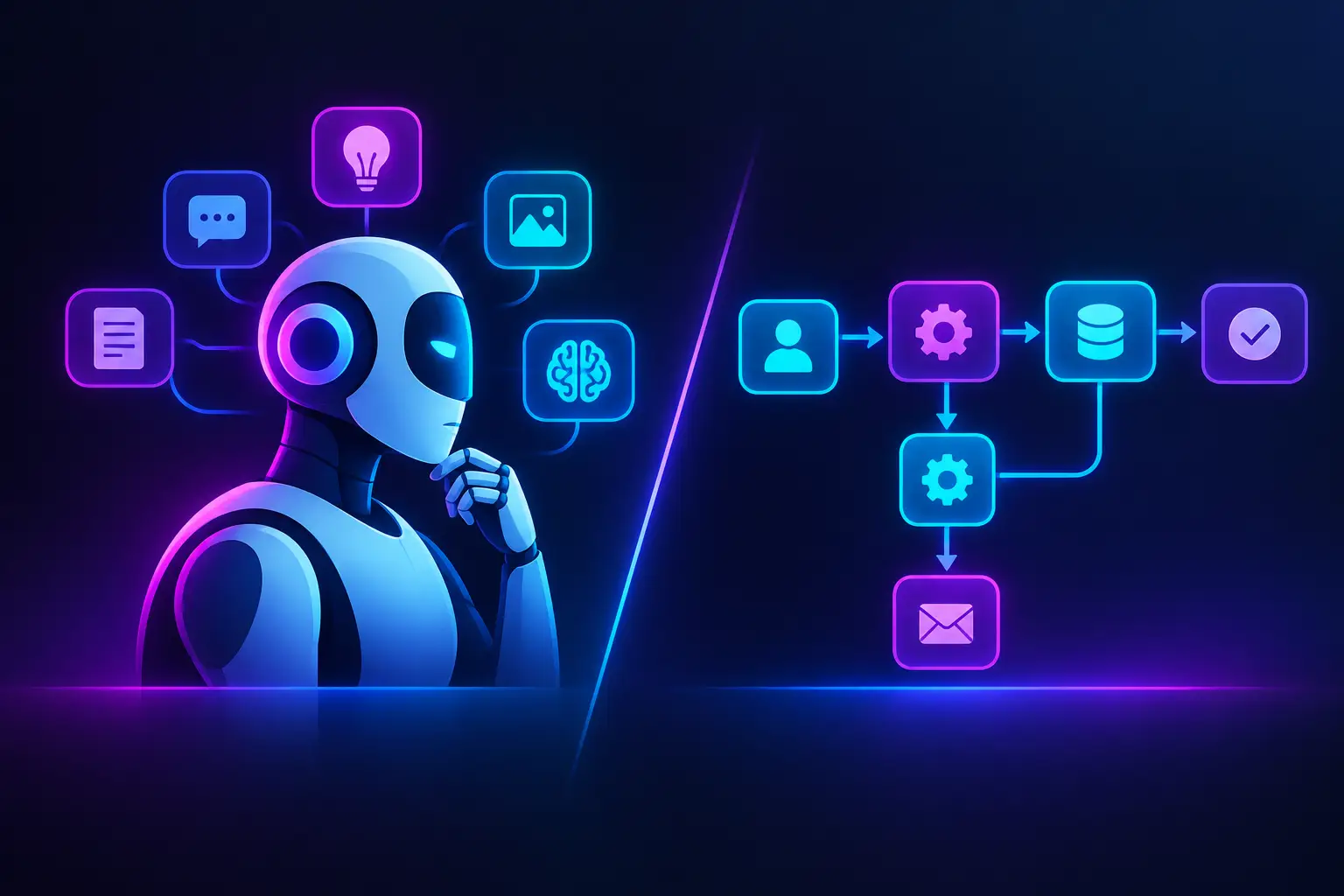
A finance leader asks for an automated exception-handling process. A product team proposes an AI agent that can investigate issues, interpret policy, and draft a response. Both may describe the initiative as automation. They are not proposing the same system. The distinction between AI agents vs automation workflows determines how reliably the process behaves, where risk sits, and what leadership must govern.
This is not a debate about whether AI is more advanced. It is an architectural decision about control. Automation workflows are designed to execute defined processes consistently. AI agents are designed to pursue an objective within a set of instructions, tools, and constraints. Each has a legitimate place. Problems begin when organizations apply one model where the other is required.
Two Operating Models, Not Two Feature Sets
An automation workflow follows a prescribed path. When a specific event occurs, the system applies known rules, moves data between systems, triggers approvals, and records the result. Its value comes from repeatability. If an invoice arrives without a purchase order, route it for review. If a customer changes a plan, update billing and notify the account team. The expected behavior can be mapped before implementation.
An AI agent works from an objective rather than a fully prescribed sequence. It may assess a request, determine which systems or knowledge sources are relevant, select a permitted tool, and decide what to do next based on the results. That capability is useful where inputs vary, context matters, and a fixed decision tree would become unmanageable.
The difference is material. A workflow executes logic you have already defined. An agent applies bounded judgment to situations you cannot completely define in advance. One is primarily a process engine. The other is a decision-making component that must be treated as such.
AI Agents vs Automation Workflows: The Core Difference
The simplest test is to ask whether the work requires interpretation. If the correct action can be expressed as stable rules with predictable exceptions, use a workflow. If the system must understand unstructured information, reconcile competing signals, or choose among several valid paths, an agent may be appropriate.
Consider customer onboarding. A workflow can create accounts, validate required fields, provision standard access, and issue notifications. Those steps are operationally important, but they are deterministic. Introducing an agent adds little value unless the process must interpret complex documentation, identify unusual risk factors, or coordinate nonstandard requirements across systems.
Now consider a support escalation involving a strategic account, a service outage, several contract commitments, and prior executive correspondence. A workflow can assign the case and gather records. An agent can help synthesize the context, identify relevant obligations, recommend a response path, and prepare a draft for human approval. The workflow provides dependable execution. The agent provides contextual reasoning. Together, they can support a stronger operating model than either approach alone.
Workflows optimize certainty
Workflows are easier to test because their paths are known. They are typically easier to audit, cost, and explain to operations teams. Their constraints are also their strength: a workflow does not improvise when the process requires consistency.
This makes workflows the better default for high-volume, low-ambiguity work. Payment reminders, access provisioning, data synchronization, compliance attestations, status notifications, and standard approval routing generally belong here. The objective is not to simulate judgment. It is to remove manual effort without introducing unnecessary variability.
Agents optimize bounded judgment
Agents earn their place when variation is real and the cost of encoding every scenario is high. They can classify, summarize, investigate, plan, and coordinate actions across approved tools. But that flexibility introduces a new class of failure modes. An agent can select an irrelevant source, interpret policy incorrectly, take an authorized action at the wrong time, or consume more resources than expected.
That does not make agents unsuitable for enterprise use. It means they require deliberate boundaries. The question is never whether an agent is intelligent enough to act. The question is whether the organization has defined what it may access, decide, spend, and escalate.
Choose Based on the Work, Not the Hype
Executives should resist the assumption that every automation opportunity needs an agent. Agentic capability is not a substitute for process design. In fact, a poorly understood process becomes harder to control when an agent is placed in the middle of it.
Start by examining the decision surface. How variable are the inputs? How many valid outcomes exist? What is the financial, legal, operational, or reputational impact of an incorrect action? How easily can a human review the result before it changes a system of record?
A practical decision framework has four dimensions:
- Process stability: Stable, repeatable processes favor workflows. Frequent exceptions and changing context may justify an agent.
- Decision ambiguity: Clear business rules favor workflows. Interpretation of documents, conversations, or competing signals may require agentic reasoning.
- Action consequence: The higher the consequence of action, the stronger the approval gates, permissions, and audit requirements must be.
- Evidence quality: Agents need authoritative, current sources. If the underlying knowledge is fragmented or unreliable, the first priority is information architecture, not deployment.
Many initiatives will land in the middle. The right pattern is often a workflow that invokes an agent for a narrow reasoning task, then returns the result to a controlled process. For example, an agent may classify an incoming request and explain its recommendation, while the workflow applies routing rules, collects approvals, and executes the final action.
This hybrid pattern preserves the value of agentic reasoning without allowing open-ended behavior to govern core operations. It also improves observability. Teams can identify whether a failure came from the model's interpretation, a policy decision, a source system, or the workflow itself.
Governance Is the Real Enterprise Requirement
The moment an agent can call tools, access enterprise data, or initiate actions, it becomes part of the control environment. It needs an identity, explicit permissions, policy enforcement, activity records, and spending limits. Those requirements are not implementation details to address after a prototype succeeds. They are part of the product definition.
A useful governance model separates what an agent can recommend from what it can execute. An agent may be allowed to retrieve account history, analyze a contract, and draft an exception request. It may not be allowed to alter pricing, transmit regulated information, or deactivate an account without a defined approval path. These distinctions should be enforced technically, not left to prompt language alone.
Leadership also needs visibility into agent performance over time. Traditional workflow metrics focus on completion rate, duration, and exception volume. Agent operations require additional measures: tool usage, action approval rates, source quality, policy violations, task success, failure recovery, and cost per completed outcome. Without this evidence, an organization cannot determine whether the agent is creating operational value or simply producing convincing output.
This is where architecture and operating governance converge. Axionic Agents is designed around the enterprise controls that turn agentic capability into an accountable operating component, including orchestration, security, policy enforcement, and billing control. The principle applies regardless of platform: intelligence without control is not an enterprise architecture.
Design the Boundary Before You Build
The most productive question is not, “Where can we use an agent?” It is, “Where should judgment stop and controlled execution begin?” That boundary should be explicit in the technical design.
Define the business objective, the permitted tools, the authoritative data sources, the decisions the agent may make, and the events that require escalation. Then define the workflow around it: inputs, approvals, system updates, exception handling, and audit records. This creates a system that can evolve without sacrificing accountability.
For organizations moving quickly with AI-generated or lightly governed product builds, this discipline is especially valuable. A prototype can appear capable while masking weak permissions, unclear ownership, fragile integrations, and missing failure controls. The faster a system reaches users, the more expensive those omissions become.
The right choice between agents and workflows is therefore not a technology preference. It is a decision about how the business intends to operate. Use workflows where certainty creates value. Use agents where bounded judgment creates leverage. Build the architecture so both remain visible, governable, and worthy of the decisions they are allowed to influence.