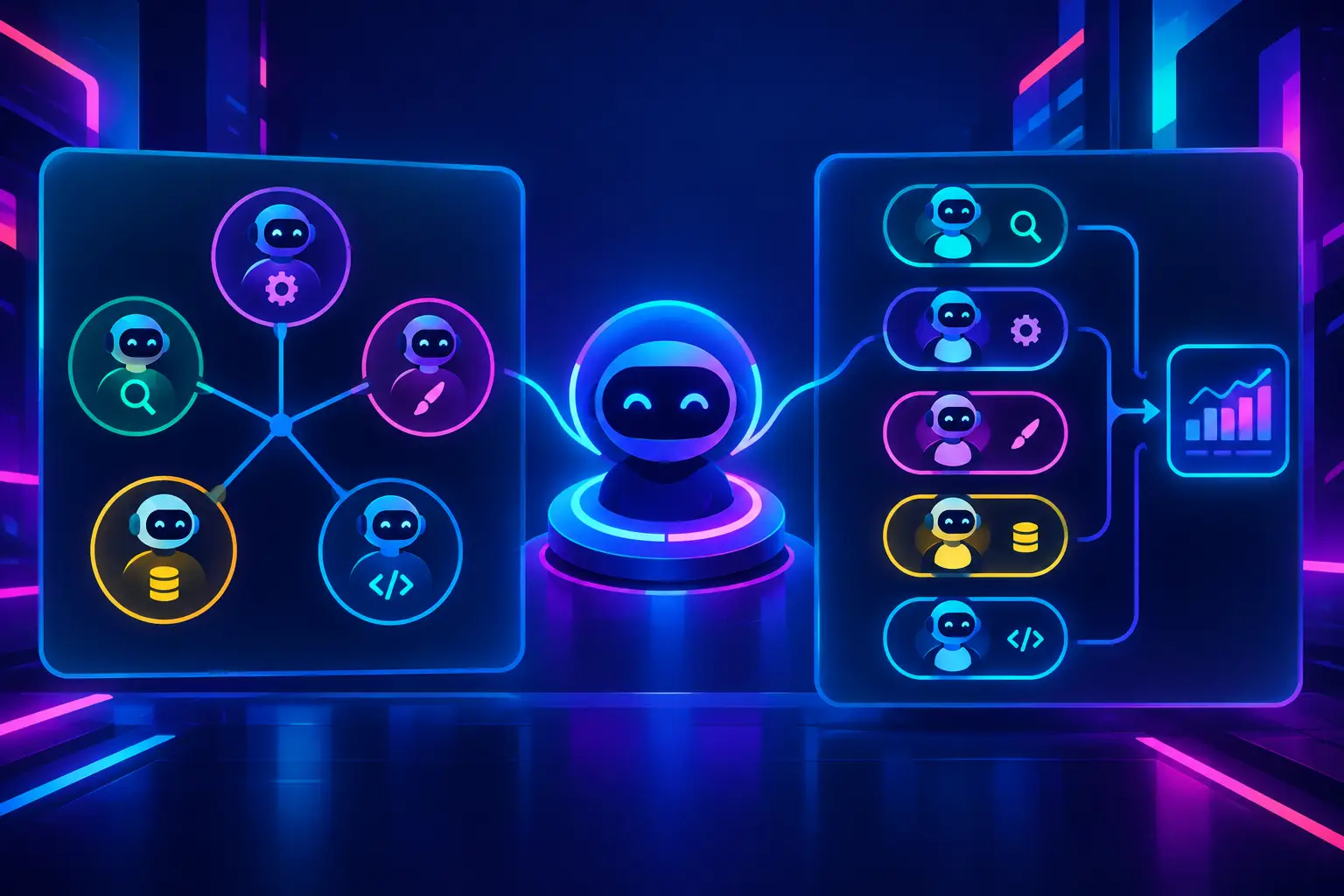
An agent orchestration comparison should not begin with a feature checklist. It should begin with a business question: who is accountable when autonomous systems take action across customer data, internal tools, financial processes, and production workflows? The answer determines whether an organization needs a lightweight coordination layer, a developer framework, or an enterprise operating model for agents.
Many platforms can route a prompt, call a tool, and return an answer. Far fewer can establish control over how agents are authorized, observed, constrained, billed, changed, and retired. For leaders moving beyond experimentation, that distinction is the comparison.
Agent Orchestration Comparison Starts With Operating Risk
Agent orchestration is the coordination layer that directs multiple AI agents, models, tools, data sources, and workflows toward an outcome. In a simple implementation, it may decide which agent handles a request and in what order. In a production environment, it must also govern identity, permissions, escalation paths, failure handling, auditability, and cost.
This is why the market can appear confusing. Products often use the same language while solving different problems. Some are optimized for rapid prototyping. Others provide workflow automation with AI capabilities. Others focus on model access, observability, or security. An enterprise agent platform must bring these concerns together without forcing every business process into a rigid pattern.
The right choice depends on the consequence of agent action. An internal research assistant that summarizes public information has a different risk profile from an agent that changes records in a CRM, initiates a refund, analyzes regulated data, or triggers work in a supply chain system. Treating them as equivalent creates a governance gap before deployment begins.
The Four Architecture Models
A useful comparison separates agent orchestration approaches by the architectural responsibility they assume.
1. Code-first frameworks
Code-first frameworks give engineering teams building blocks for agent loops, tool use, memory, routing, and multi-agent collaboration. They are flexible and can accelerate early development when teams have strong AI engineering capability.
Their trade-off is that the enterprise controls often remain the responsibility of the organization. Security policy, identity design, audit records, approval workflows, cost allocation, monitoring, and lifecycle management must be designed around the framework. This can be the right decision for a differentiated product where bespoke behavior matters. It is less attractive when every team is independently rebuilding the same guardrails.
2. Workflow and automation platforms
Workflow platforms are effective when the process is already well defined. They connect systems, apply rules, and increasingly add AI steps for classification, drafting, extraction, or decision support. They can be a practical choice for bounded, repeatable processes with clear handoffs.
The limitation appears when agents need to reason across changing context, choose among tools, collaborate with other agents, or operate under varying levels of authority. A workflow engine can coordinate actions, but it is not automatically an agent governance layer. Organizations should test how it manages unpredictable paths rather than assuming an AI-enabled workflow can safely support autonomous operations.
3. Model-provider agent tooling
Model providers are adding hosted agent capabilities, tool calling, retrieval functions, and managed execution environments. These services can reduce infrastructure burden and provide fast access to new model features.
They also introduce strategic dependencies. Leaders should examine portability, data boundaries, logging access, identity integration, model substitution, and the extent to which policy can remain consistent when more than one model provider is required. A single-provider design may be efficient at first and costly to unwind later.
4. Enterprise orchestration and governance platforms
Enterprise platforms position orchestration as a control plane. They coordinate agent execution while applying policy, permissioning, observability, financial controls, and human intervention across the agent estate.
This approach is appropriate where AI must operate across business systems and organizational boundaries. Its value is not simply that it runs agents. Its value is that it gives executives, architects, security teams, and operators a shared mechanism for deciding what agents are allowed to do and proving what they did.
The trade-off is intentionality. A control plane requires clear architecture decisions: identity sources, data classification, ownership, escalation criteria, and integration standards. Organizations looking for a one-click substitute for governance will be disappointed. Organizations prepared to establish operating discipline will gain a more durable foundation.
What to Compare Beyond Features
A serious agent orchestration comparison should examine the mechanics of control, not just the quality of a demonstration. Four questions expose most of the architectural differences.
Can policy follow the agent?
Policies should not be buried inside individual prompts or application code. An enterprise needs to define which agent can access which tools, data domains, and transaction types, then enforce those policies consistently. The platform should support different authority levels, from read-only research to actions that require approval before execution.
This matters when agents are reused across teams. A capable agent may be safe in one context and unacceptable in another. Reusable capability without reusable policy creates an uncontrolled distribution problem.
Is identity designed for autonomous work?
Human identity and agent identity are not the same. Agents need attributable identities, scoped credentials, time-bound access, and a clear relationship to the person, team, or process that authorized them. Shared service accounts and hard-coded secrets are incompatible with accountable agent operations.
Ask whether the orchestration layer can enforce least-privilege access at the moment a tool is called. Also ask whether it can preserve a traceable chain from the initiating user or system through every agent and downstream action. Without that chain, incident response becomes reconstruction rather than governance.
Can leaders see cost and value at the right level?
Token consumption is only one component of agent cost. A meaningful view includes model usage, tool calls, retrieval operations, human review, failed runs, and the operating cost of the workflow the agent replaces or changes.
The platform should make it possible to allocate spend by business unit, product, customer, agent, and process. Otherwise, an organization may know that AI usage is increasing without knowing whether it is improving margins, reducing cycle time, or introducing avoidable expense. Billing control is a management requirement, not an accounting afterthought.
What happens when an agent is wrong?
No model, prompt, or evaluation suite removes the possibility of failure. The relevant question is whether the system contains failure appropriately. Look for approval gates, fallback behavior, retry limits, tool-level restrictions, exception queues, kill switches, and records that explain why an action was taken.
The most mature implementations design for intervention from the start. They identify decisions that agents may make independently, decisions they may recommend, and decisions that remain human-owned. That structure preserves velocity without transferring accountability to an opaque process.
Avoid the Single-Platform Assumption
There is rarely one platform that should own every layer of an AI architecture. A company may use a code-first framework for product differentiation, a workflow tool for operational automation, and an orchestration control plane for cross-cutting policy and visibility. The architecture should reflect the business function, risk level, and expected rate of change.
The mistake is allowing this mixed environment to evolve without standards. Different teams will choose different models, build inconsistent tool connectors, create incompatible audit trails, and apply security controls unevenly. What begins as productive experimentation can become an unmanageable fleet of autonomous applications.
This is where senior architecture matters. The organization needs a reference design that distinguishes local implementation freedom from enterprise-wide controls. It should establish how agents are registered, how tools are approved, how data access is governed, how evaluations are performed, and who owns operational decisions after release.
Axionic Agents is designed around this control-plane requirement: providing orchestration alongside security, policy enforcement, and billing control rather than treating each as a separate retrofit.
A Better Selection Process
Do not select an orchestration platform from a scripted demo. Select it against two or three representative use cases with different risk levels. For example, test a knowledge agent, an operational agent that writes to a business system, and a multi-agent process that requires human approval. The platform should demonstrate not only successful execution but also denied actions, failures, handoffs, policy changes, and cost reporting.
Bring architecture, security, operations, finance, and product leadership into the evaluation early. Each group sees a different failure mode. Engineering may value extensibility, security may focus on permissions and data exposure, operations may need recoverability, finance may require allocation controls, and product leadership may need a credible path from pilot to scale.
The strongest decision is rarely the platform with the longest feature list. It is the one that fits the organization’s operating model while leaving room for change. Agent capabilities will evolve quickly. Your ability to govern their use cannot remain an experiment.